Symbols
According to Goldammer and Artur, theories of religious symbolism doesn’t have to be a concrete item such as the cross in Christianity but can be abstract or a reinterpretation which in turn makes the symbol more meaningful to the religious follower. I argue this theory can be seen as the Man and the Boy “carrying the fire” their main method symbolic performance, whereby humanity is preserved in the soul. Additionally, the unconscious and its relation to religion is mentioned in the article which I argue is in correlation with the Man and the Boy; the Man unconsciously realizes the Boy is God.
What the eucharist is the Christians, carrying the fire is to the Man and the Boy- (Potts)
“Then they set out upon the road again, slumped and cowled and shivering in their rags like mendicant friars sent forth to find their keep.” (McCarthy, 126)
“Out on the road the pilgrims sank down and fell over and died and the bleak and shrouded earth went trundling past the sun and returned again as tackless and as unremarked as the path of any maneless sisterworld in the ancient dark beyond” (McCarthy, 181)
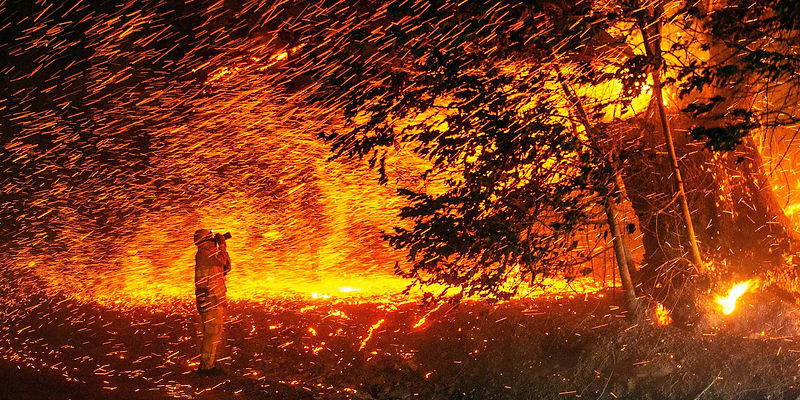
"Cormac McCarthy's novel The Road is a work suffused with Christian imagery, as can be seen in the recurring motifs of fire and darkness. Fire is a complex and ambiguous symbol, both in the novel and in Judeo-Christian tradition. Fire has obvious negative associations of hellfire and the fires of lust, for example, but in the Old Testament God himself is twice described as a "consuming fire". In that context, fire is a purifying force...while fire is usually presented as destructive, there is also a positive side to it. Fire in the novel also represents civilization, the possibility of technological development and a more secure life." (Pudney)
“We’re going to be okay, arent we Papa? Yes. We are. And nothing bad is going to happen to us. That’s right. Because we’re carrying the fire. Yes. Because we’re carrying the fire” (McCarthy, 83)
The Mission of the Man and the Boy
The Man has three main goals in McCarthy's novel; keep the boy alive, prevent evil from taking them, and going to the sea. While fire is necessary in the apocalyptic wasteland to keep warm, and is essential to survival, the Man uses the phrase "carrying the fire" to connote carrying goodness and humanity within them.
The Continuation of Carrying the Fire
As Decoste notes, the Father offers his faith to the Boy, and his death, which I believe acts as a catalyst for the Boy to continue his mission: preaching the importance of carrying the fire, demonstrated when he joins another family of which he believes to be "one of the good guys". As noted in Rituals, the boy fulfills his promise to his father to remain godly, and preach this message, (while simultaneously teaching the man his convictions) by communicating with him after his death through remembrance.
“You have to carry the fire. Where is it? I dont know where it is. Yes you do. Its inside you. It was always there. I can see it… You have my whole heart. You always did. You’re the best guy. You always were. If i’m not here you can still talk to me. You can talk to me and I’ll talk to you” (McCarthy, 278-279)
“She would talk to him sometimes about God. He tried to talk to God but the best thing was to talk to his father and he did talk to him and didnt forget. The woman said that was all right. She said that the breath of God was his breath yet though it pass from man to man through all of time” (McCarthy, 286)
The Conclusion: Carrying the Fire